StoryKit is a fun -- and free -- app.
Well then, where in the world can you get it?
From iTunes.
You can download it right now from iTunes for free.
Designed by researchers at the University of Maryland in the USA, StoryKit comes to us from the ICDL (International Children's Digital Library) Foundation.
Use it to create an electronic storybook.
For free.
On your iPhone, iPad, or iPod touch.
Make any story you like. Simply write some words, and add drawings or photos.
To get you started, the StoryKit application comes with 4 public domain children's books.
Rearrange -- edit and change -- any of the 4 books to make a new story that suits your point of view.
It's a lovely, creative way to spend a few spare moments.
Do it by yourself. Or in a group.
How about using this free app to organize a story contest -- on a trip with friends, for example -- just an informal, amicable contest, of course!
Plus, if you're a teacher, find ways to use StoryKit in the classroom.
First, choose a topic for the story.
If you like, ask your students for ideas.
But keep an eye on the clock -- time management is an essential part of any lesson.
So, in one way or another, quickly decide on a title for the story.
Then, each student could come up with a sentence. Or a drawing. Or a photo.
As a result, the whole story would be made up of parts contributed by each student.
In other words, the story would be a joint effort.
A group activity in which everyone would have to take part by giving a sentence or a picture.
It's a great way to spark creativity in anyone, whatever their age.
So, here's the link to the free StoryKit application on iTunes:
https://itunes.apple.com/us/app/storykit/id329374595?mt=8
Enjoy!
Showing posts with label Art. Show all posts
Monday, 21 November 2016
Monday, 14 November 2016
Read children's books -- in many languages -- online -- for FREE -- at the International Children's Digital Library
A wonderful online library,
located in America (in the U.S.A.)
where you can get so many children's books
-- in so many languages, including English, of course,
-- to read online
-- for FREE !
The name of the site:
International Children's Digital Library
The link to the site:
http://www.childrenslibrary.org/
There are books in various languages from:
-- North America and Central America
-- South America
-- Asia and Middle East
-- Oceania
-- Europe
-- Africa
And, of course, there are oodles of books
available in English.
Take a look at the various books offered
by using the site's location search.
Here's the link to their location search:
http://www.childrenslibrary.org/icdl/SearchWorld?area=0&type=text&ilang=English
Plus, if you go to the site's "Using the Library" page,
you can get advice to help you with
creative writing, learning languages,
and other good tips.
There's even a teacher training manual.
So, to get to the "Using the Library" page
mentioned above, click on this link:
http://en.childrenslibrary.org/books/activities/index.shtml
In addition, on the library's home page,
take a look at the left-hand side.
Examine the sidebar there.
Under THE FOUNDATION,
you'll find help and advice for
authors & publishers,
translators,
researchers & librarians,
and even an Ambassador program.
Well then, for those people who'd like to try their hand at
writing
or illustrating
or translating
a c h i l d r e n ' s book,
definitely take at least a glance at the website of the
International Children's Digital Library.
You never know, it could be the start
of a new career for you.
You could become a writer,
illustrator, or translator
of children's books.
* * * * * * * You could also become a volunteer,
or make a donation,
or buy something at their online gift shop.
The online gift shop for the
International Children's Digital Library
can be found at:
http://www.cafepress.com/icdl_gift_shop
All for the very good cause
of free international children's books.
located in America (in the U.S.A.)
where you can get so many children's books
-- in so many languages, including English, of course,
-- to read online
-- for FREE !
The name of the site:
International Children's Digital Library
The link to the site:
http://www.childrenslibrary.org/
There are books in various languages from:
-- North America and Central America
-- South America
-- Asia and Middle East
-- Oceania
-- Europe
-- Africa
And, of course, there are oodles of books
available in English.
Take a look at the various books offered
by using the site's location search.
Here's the link to their location search:
http://www.childrenslibrary.org/icdl/SearchWorld?area=0&type=text&ilang=English
Plus, if you go to the site's "Using the Library" page,
you can get advice to help you with
creative writing, learning languages,
and other good tips.
There's even a teacher training manual.
So, to get to the "Using the Library" page
mentioned above, click on this link:
http://en.childrenslibrary.org/books/activities/index.shtml
In addition, on the library's home page,
take a look at the left-hand side.
Examine the sidebar there.
Under THE FOUNDATION,
you'll find help and advice for
authors & publishers,
translators,
researchers & librarians,
and even an Ambassador program.
Well then, for those people who'd like to try their hand at
writing
or illustrating
or translating
a c h i l d r e n ' s book,
definitely take at least a glance at the website of the
International Children's Digital Library.
You never know, it could be the start
of a new career for you.
You could become a writer,
illustrator, or translator
of children's books.
* * * * * * * You could also become a volunteer,
or make a donation,
or buy something at their online gift shop.
The online gift shop for the
International Children's Digital Library
can be found at:
http://www.cafepress.com/icdl_gift_shop
All for the very good cause
of free international children's books.
Labels:
Art,
Books,
Education,
English,
Good causes
Saturday, 5 November 2016
Netherlandish Proverbs painting -- INTERACTIVE version -- point and view each proverb
Here's the ♥ link to an interesting interactive version of
Netherlandish Proverbs, the famous painting by
Pieter Bruegel the Elder.
♥ http://bruegel.analog.is/
When you click on the link, you'll see
a large white X -- X -- on the upper right-hand corner.
Click on that.
You'll get the interactive picture.
Use your mouse to place your pointer (mouse cursor)
on each small yellow ring in the interactive painting.
You will then be able to read the relevant proverb/idiom.
♥ Try to guess the proverb/idiom before
you put your pointer on each yellow ring!
♥ After you've read them all, try to remember each one.
That's a good way to test and train your memory.
On the upper left-hand corner is a small white box
with a plus and minus sign -- click them to make the
picture larger or smaller.
O By the way, if you can't see the small yellow rings,
look at the upper right-hand corner of the picture.
You'll see a small white box with something that
looks like a stack of three papers.
Put your pointer (mouse cursor) on that white box.
The word "Proverbs" will appear,
with a tiny box in front of the word.
Is the tiny box checked -- does it have a tick mark?
If not, click the word "Proverbs" -- to make a tick appear
in that tiny box.
You should then be able to see the small yellow
rings in the interactive painting.
Of all the proverbs/idioms, which one resonates the most with you?
Is there a similar saying in your own language
or in another language that you have learnt?
Share this interactive picture with your friends
and see how many they can guess correctly. ♥
Netherlandish Proverbs, the famous painting by
Pieter Bruegel the Elder.
♥ http://bruegel.analog.is/
When you click on the link, you'll see
a large white X -- X -- on the upper right-hand corner.
Click on that.
You'll get the interactive picture.
Use your mouse to place your pointer (mouse cursor)
on each small yellow ring in the interactive painting.
You will then be able to read the relevant proverb/idiom.
♥ Try to guess the proverb/idiom before
you put your pointer on each yellow ring!
♥ After you've read them all, try to remember each one.
That's a good way to test and train your memory.
On the upper left-hand corner is a small white box
with a plus and minus sign -- click them to make the
picture larger or smaller.
O By the way, if you can't see the small yellow rings,
look at the upper right-hand corner of the picture.
You'll see a small white box with something that
looks like a stack of three papers.
Put your pointer (mouse cursor) on that white box.
The word "Proverbs" will appear,
with a tiny box in front of the word.
Is the tiny box checked -- does it have a tick mark?
If not, click the word "Proverbs" -- to make a tick appear
in that tiny box.
You should then be able to see the small yellow
rings in the interactive painting.
Of all the proverbs/idioms, which one resonates the most with you?
Is there a similar saying in your own language
or in another language that you have learnt?
Share this interactive picture with your friends
and see how many they can guess correctly. ♥
Labels:
Art,
English,
Paintings,
Quizzes and trivia
Monday, 31 October 2016
A classic painting full of good advice -- Netherlandish Proverbs by Pieter Bruegel the Elder
A fun and very educational work of art.
Even though it was done in the 16th century,
it still has a lot of relevance in the world of today.
The title of the painting: Netherlandish Proverbs
Painted in 1559 by Pieter Bruegel the Elder, it is well-known for its illustration of proverbs and idioms.
As the saying goes, "a picture is worth a thousand words".
Well, Netherlandish Proverbs is a picture which is worth at least a hundred proverbs and idioms that can be identified in the scene it depicts.
Here's the painting.
(Click on the painting to enlarge it).
Take a good look at the picture, examine it carefully, and try to spot as many proverbs as you can.
For instance, here's a detail from the left part of the painting, under one of the wooden shutters of the window:
The above part of the picture depicts the expression
"it depends on the fall of the cards"
meaning
"it is up to chance".
Here are some other details from the painting.
Try your luck and see whether you can guess the proverb/idiom each is meant to illustrate.
To get the answers to the above pictorial puzzles,
and for a detailed article on the Netherlandish Proverbs painting,
including all the pictures shown in this post,
here is the Wikipedia link:
https://en.wikipedia.org/wiki/Netherlandish_Proverbs
Even though it was done in the 16th century,
it still has a lot of relevance in the world of today.
The title of the painting: Netherlandish Proverbs
Painted in 1559 by Pieter Bruegel the Elder, it is well-known for its illustration of proverbs and idioms.
As the saying goes, "a picture is worth a thousand words".
Well, Netherlandish Proverbs is a picture which is worth at least a hundred proverbs and idioms that can be identified in the scene it depicts.
Here's the painting.
(Click on the painting to enlarge it).
Take a good look at the picture, examine it carefully, and try to spot as many proverbs as you can.
For instance, here's a detail from the left part of the painting, under one of the wooden shutters of the window:
The above part of the picture depicts the expression
"it depends on the fall of the cards"
meaning
"it is up to chance".
Here are some other details from the painting.
Try your luck and see whether you can guess the proverb/idiom each is meant to illustrate.
To get the answers to the above pictorial puzzles,
and for a detailed article on the Netherlandish Proverbs painting,
including all the pictures shown in this post,
here is the Wikipedia link:
https://en.wikipedia.org/wiki/Netherlandish_Proverbs
Labels:
Art,
English,
Paintings,
Quizzes and trivia
Sunday, 20 December 2015
A Mary Cassatt painting and Pride and Prejudice by Jane Austen
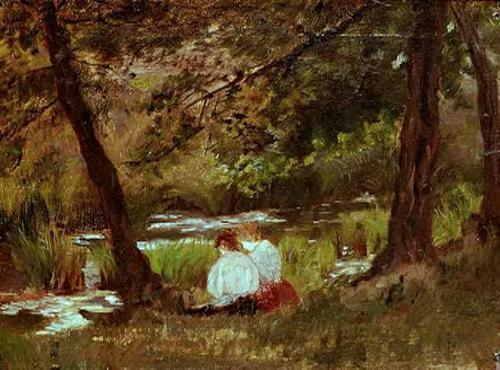
Here is a painting by Mary Cassatt called
"Two women seated by a woodland stream".
What a lovely, serene picture.
When I saw the painting, it made me think of the two elder Bennet sisters in Pride and Prejudice by Jane Austen.
It made me picture Jane Bennet and Elizabeth Bennet taking a rest after a walk by a stream in a garden at or near Longbourn, or perhaps in the parkland at Pemberley (after Elizabeth married Darcy)...
http://www.wikiart.org/en/mary-cassatt/two-seated-women-1869
https://en.wikipedia.org/wiki/Mary_Cassatt
By the way, Pride and Prejudice by Jane Austen is available to read online for free at the Project Gutenberg site.
http://www.gutenberg.org/files/1342/1342-h/1342-h.htm#link2HCH0061
Project Gutenberg is a wonderful site where you can read thousands of books for free online. Do take a moment to visit it.
https://www.gutenberg.org/
"Two women seated by a woodland stream".
What a lovely, serene picture.
When I saw the painting, it made me think of the two elder Bennet sisters in Pride and Prejudice by Jane Austen.
It made me picture Jane Bennet and Elizabeth Bennet taking a rest after a walk by a stream in a garden at or near Longbourn, or perhaps in the parkland at Pemberley (after Elizabeth married Darcy)...
http://www.wikiart.org/en/mary-cassatt/two-seated-women-1869
https://en.wikipedia.org/wiki/Mary_Cassatt
By the way, Pride and Prejudice by Jane Austen is available to read online for free at the Project Gutenberg site.
http://www.gutenberg.org/files/1342/1342-h/1342-h.htm#link2HCH0061
Project Gutenberg is a wonderful site where you can read thousands of books for free online. Do take a moment to visit it.
https://www.gutenberg.org/
Labels:
Art,
Books,
Nature,
Paintings,
Pride and Prejudice
Monday, 12 October 2015
A knightly painting by John William Waterhouse
Here is a painting by John William Waterhouse.
What is the name of the painting?
a) Lancelot and Guinevere
b) La belle dame sans merci
c) Mélisande
d) Tristan and Iseult
NB. The answer to the above trivia question can be found here:
click here -- it will take you to a Wikipedia site for the answer
and here's some information regarding the artist:
https://en.wikipedia.org/wiki/John_William_Waterhouse
Plus, take a look at this art blog:
http://gather-ye-rosebuds-while-ye-may.blogspot.sg
and here's a poem by John Keats
with regard to the above painting:
http://www.bartleby.com/126/55.html
What is the name of the painting?
a) Lancelot and Guinevere
b) La belle dame sans merci
c) Mélisande
d) Tristan and Iseult
NB. The answer to the above trivia question can be found here:
click here -- it will take you to a Wikipedia site for the answer
and here's some information regarding the artist:
https://en.wikipedia.org/wiki/John_William_Waterhouse
Plus, take a look at this art blog:
http://gather-ye-rosebuds-while-ye-may.blogspot.sg
and here's a poem by John Keats
with regard to the above painting:
http://www.bartleby.com/126/55.html
Subscribe to:
Posts (Atom)