Here's the ♥ link to an interesting interactive version of
Netherlandish Proverbs, the famous painting by
Pieter Bruegel the Elder.
♥ http://bruegel.analog.is/
When you click on the link, you'll see
a large white X -- X -- on the upper right-hand corner.
Click on that.
You'll get the interactive picture.
Use your mouse to place your pointer (mouse cursor)
on each small yellow ring in the interactive painting.
You will then be able to read the relevant proverb/idiom.
♥ Try to guess the proverb/idiom before
you put your pointer on each yellow ring!
♥ After you've read them all, try to remember each one.
That's a good way to test and train your memory.
On the upper left-hand corner is a small white box
with a plus and minus sign -- click them to make the
picture larger or smaller.
O By the way, if you can't see the small yellow rings,
look at the upper right-hand corner of the picture.
You'll see a small white box with something that
looks like a stack of three papers.
Put your pointer (mouse cursor) on that white box.
The word "Proverbs" will appear,
with a tiny box in front of the word.
Is the tiny box checked -- does it have a tick mark?
If not, click the word "Proverbs" -- to make a tick appear
in that tiny box.
You should then be able to see the small yellow
rings in the interactive painting.
Of all the proverbs/idioms, which one resonates the most with you?
Is there a similar saying in your own language
or in another language that you have learnt?
Share this interactive picture with your friends
and see how many they can guess correctly. ♥
Showing posts with label Paintings. Show all posts
Showing posts with label Paintings. Show all posts
Saturday, 5 November 2016
Monday, 31 October 2016
A classic painting full of good advice -- Netherlandish Proverbs by Pieter Bruegel the Elder
A fun and very educational work of art.
Even though it was done in the 16th century,
it still has a lot of relevance in the world of today.
The title of the painting: Netherlandish Proverbs
Painted in 1559 by Pieter Bruegel the Elder, it is well-known for its illustration of proverbs and idioms.
As the saying goes, "a picture is worth a thousand words".
Well, Netherlandish Proverbs is a picture which is worth at least a hundred proverbs and idioms that can be identified in the scene it depicts.
Here's the painting.
(Click on the painting to enlarge it).

Take a good look at the picture, examine it carefully, and try to spot as many proverbs as you can.
For instance, here's a detail from the left part of the painting, under one of the wooden shutters of the window:

The above part of the picture depicts the expression
"it depends on the fall of the cards"
meaning
"it is up to chance".
Here are some other details from the painting.
Try your luck and see whether you can guess the proverb/idiom each is meant to illustrate.


To get the answers to the above pictorial puzzles,
and for a detailed article on the Netherlandish Proverbs painting,
including all the pictures shown in this post,
here is the Wikipedia link:
https://en.wikipedia.org/wiki/Netherlandish_Proverbs
Even though it was done in the 16th century,
it still has a lot of relevance in the world of today.
The title of the painting: Netherlandish Proverbs
Painted in 1559 by Pieter Bruegel the Elder, it is well-known for its illustration of proverbs and idioms.
As the saying goes, "a picture is worth a thousand words".
Well, Netherlandish Proverbs is a picture which is worth at least a hundred proverbs and idioms that can be identified in the scene it depicts.
Here's the painting.
(Click on the painting to enlarge it).
Take a good look at the picture, examine it carefully, and try to spot as many proverbs as you can.
For instance, here's a detail from the left part of the painting, under one of the wooden shutters of the window:
The above part of the picture depicts the expression
"it depends on the fall of the cards"
meaning
"it is up to chance".
Here are some other details from the painting.
Try your luck and see whether you can guess the proverb/idiom each is meant to illustrate.
To get the answers to the above pictorial puzzles,
and for a detailed article on the Netherlandish Proverbs painting,
including all the pictures shown in this post,
here is the Wikipedia link:
https://en.wikipedia.org/wiki/Netherlandish_Proverbs

Sunday, 20 December 2015
A Mary Cassatt painting and Pride and Prejudice by Jane Austen
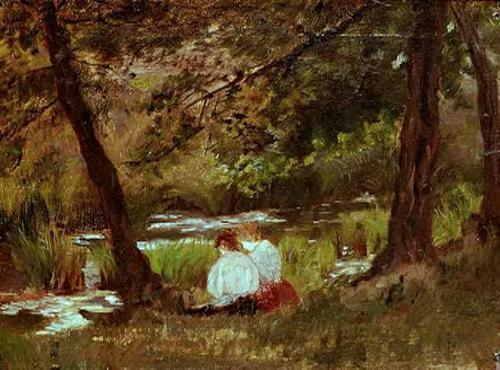
Here is a painting by Mary Cassatt called
"Two women seated by a woodland stream".
What a lovely, serene picture.
When I saw the painting, it made me think of the two elder Bennet sisters in Pride and Prejudice by Jane Austen.
It made me picture Jane Bennet and Elizabeth Bennet taking a rest after a walk by a stream in a garden at or near Longbourn, or perhaps in the parkland at Pemberley (after Elizabeth married Darcy)...

http://www.wikiart.org/en/mary-cassatt/two-seated-women-1869
https://en.wikipedia.org/wiki/Mary_Cassatt
By the way, Pride and Prejudice by Jane Austen is available to read online for free at the Project Gutenberg site.
http://www.gutenberg.org/files/1342/1342-h/1342-h.htm#link2HCH0061
Project Gutenberg is a wonderful site where you can read thousands of books for free online. Do take a moment to visit it.
https://www.gutenberg.org/
"Two women seated by a woodland stream".
What a lovely, serene picture.
When I saw the painting, it made me think of the two elder Bennet sisters in Pride and Prejudice by Jane Austen.
It made me picture Jane Bennet and Elizabeth Bennet taking a rest after a walk by a stream in a garden at or near Longbourn, or perhaps in the parkland at Pemberley (after Elizabeth married Darcy)...
http://www.wikiart.org/en/mary-cassatt/two-seated-women-1869
https://en.wikipedia.org/wiki/Mary_Cassatt
By the way, Pride and Prejudice by Jane Austen is available to read online for free at the Project Gutenberg site.
http://www.gutenberg.org/files/1342/1342-h/1342-h.htm#link2HCH0061
Project Gutenberg is a wonderful site where you can read thousands of books for free online. Do take a moment to visit it.
https://www.gutenberg.org/
Subscribe to:
Posts (Atom)